Comparisons
Tasks, credits, executions or flat plans: automation pricing compared
Zapier vs Make vs n8n pricing on the same workflows: how tasks, credits and executions are counted, a 3×3 cost matrix, hidden multipliers and how to choose.
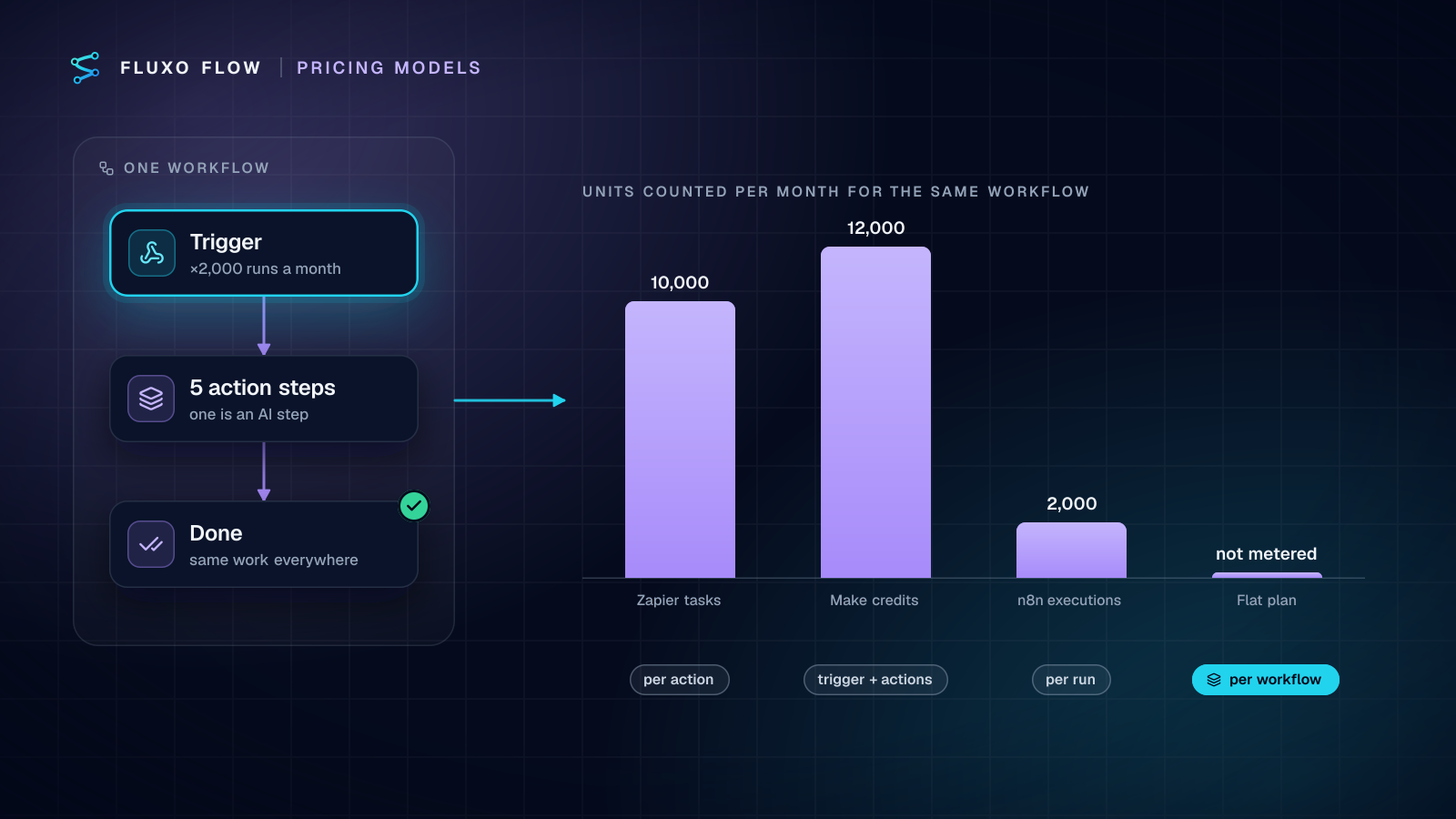
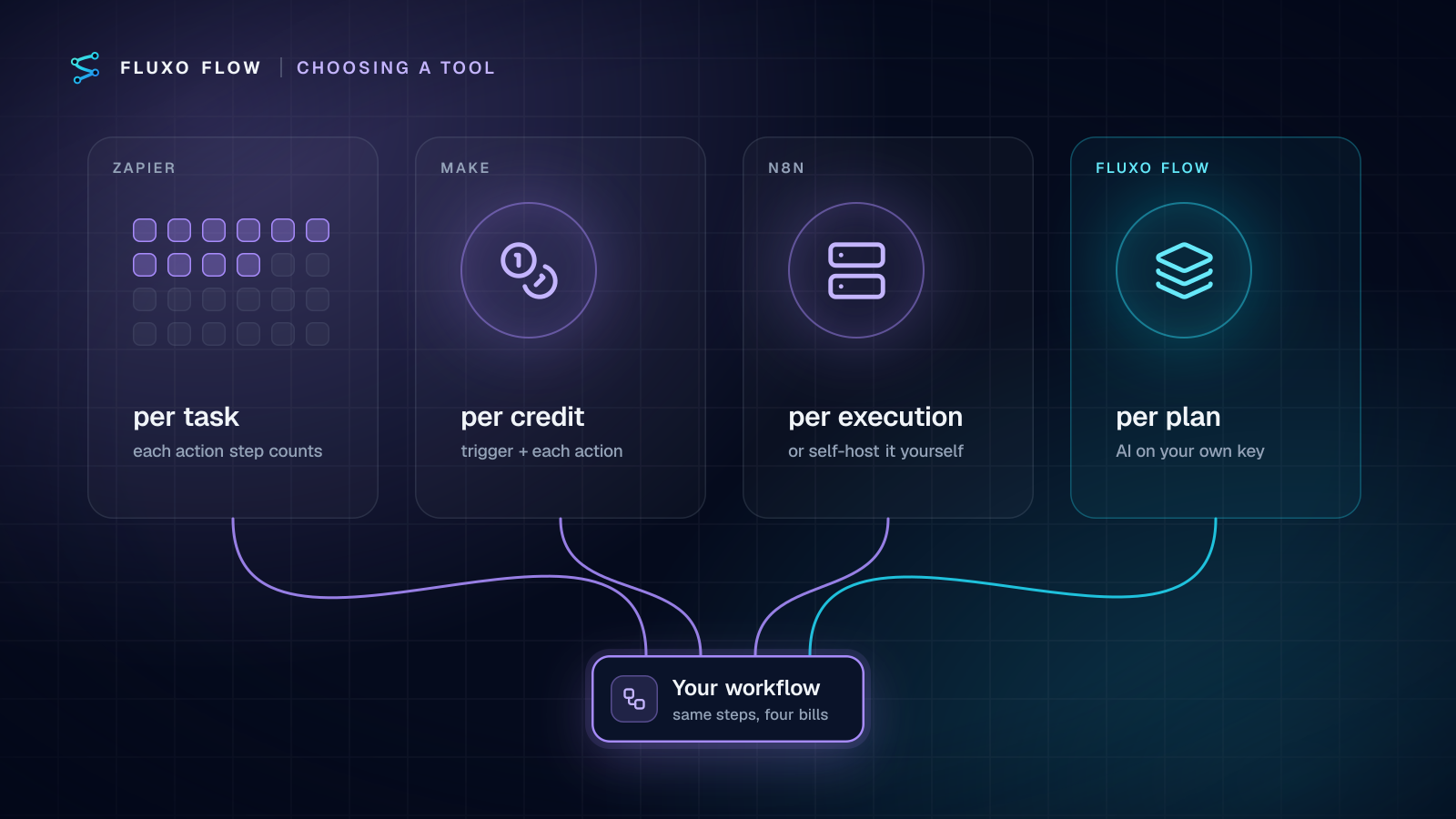
Short answer: Zapier, Make and n8n meter different things. Zapier counts tasks (each successful action step), Make counts credits (most actions plus the trigger on every run), and n8n Cloud counts executions (a whole run, however many steps). Flat-plan tools like Fluxo Flow count none of these and price by workflows and seats instead. For short workflows at low volume, Make and Zapier are cheapest. For long workflows at volume, per-execution and flat pricing win, often by a wide margin. The matrix below shows where the lines cross.
Every vendor figure here comes from the vendor's own pricing page or help center, checked on October 4, 2026, and all three tables are computed from the same price data our cost calculator uses, so you can reproduce any cell. We make Fluxo Flow, so we've kept our own row deliberately boring: it's one plan price that doesn't move.
The four pricing units, defined by the vendors
| Unit | Who uses it | What counts | What's free | Source |
|---|---|---|---|---|
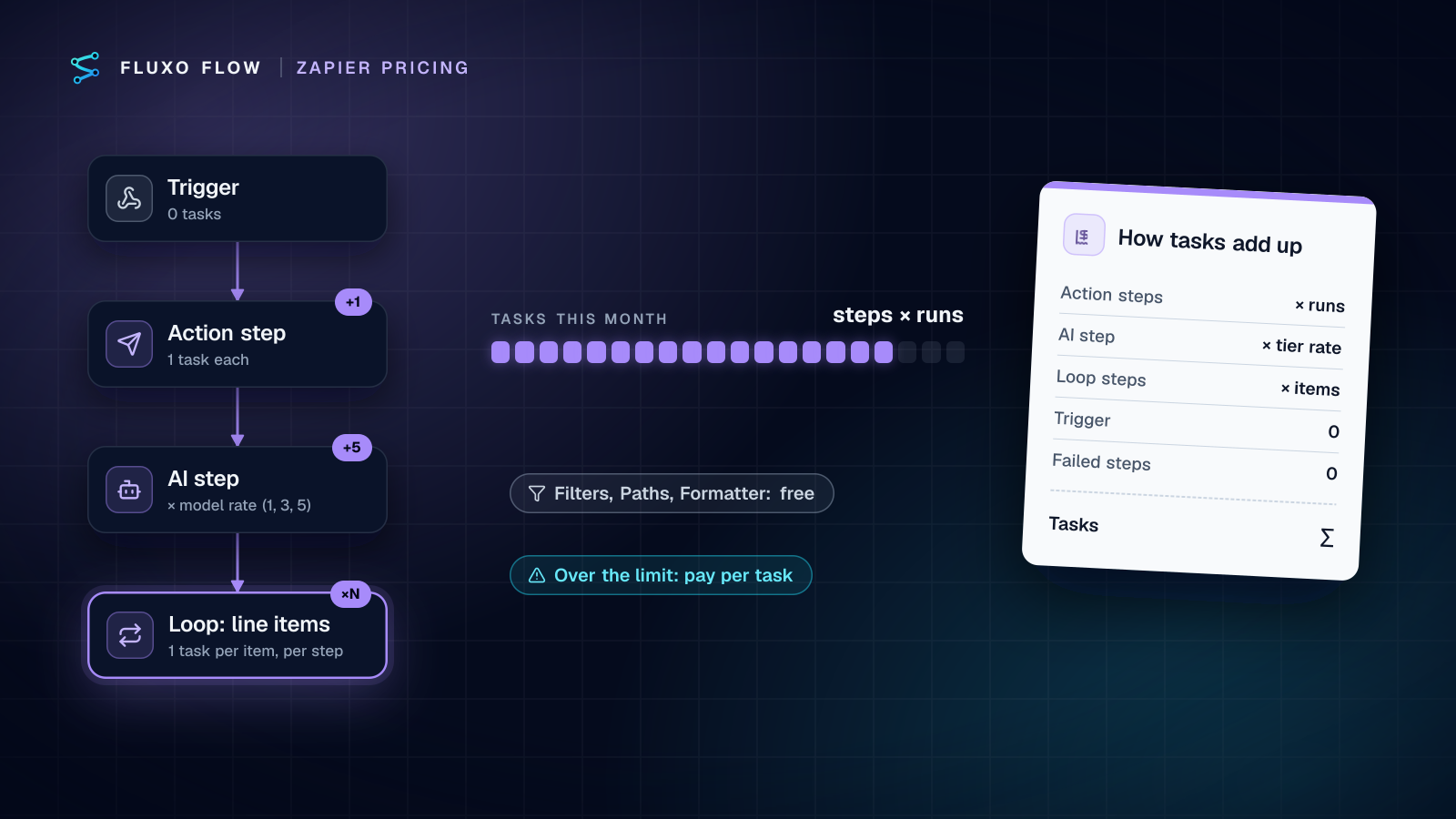
| Task | Zapier | Each successful action step, per run. AI by Zapier steps count 1, 3 or 5 by model tier, plus the same again per tool call | Triggers, polling, Filter, Paths, Formatter, failed steps | Zapier help, AI tiers |
| Credit | Make | Most module actions use 1 credit; the trigger uses 1 credit per run; Make's own AI provider converts tokens to credits | Routers; bundles passing through filters | Make Academy, Make credits |
| Execution | n8n Cloud | One run of the entire workflow, regardless of steps or data | Steps inside the run | n8n pricing |
| Plan slot | Fluxo Flow | Number of workflows, seats and the fastest schedule allowed | Runs, steps and tasks (AI tokens are billed by your own provider) | Fluxo Flow pricing |
Entry prices, as published on October 4, 2026: Zapier Professional from $19.99/month billed annually ($29.99 monthly) for 750 tasks (pricing). Make Core at $12/month for 10,000 credits, with Pro at $21 and Teams at $38 for the same credit amount (pricing). n8n Cloud Starter at €20/month and Pro at €50/month, billed annually, for 2,500 and 10,000 executions (pricing); n8n shows euros, so the currency differs from the others. Fluxo Flow starts at $39/mo for Basic (15 workflows); the Free plan builds and Dry Runs workflows but doesn't run them live.
Pools vs slots: the one idea that explains the bills
Before the numbers, notice what's being rationed.
- Zapier, Make and n8n sell a pool of units. Every workflow in your account draws from the same monthly pool. Ten small workflows and one huge one compete for the same tasks, credits or executions.
- Flat plans sell slots. You get a number of workflows and seats; what each workflow does, and how often, doesn't change the bill (within run limits and your plan's schedule floor).
This is why comparing one workflow in isolation can mislead you. The honest comparison is total units across your account on a metered tool versus number of workflows and seats on a flat one. Keep that in mind as you read the single-workflow tables.
The test workflows
Three workflow shapes at three monthly volumes, nine scenarios in all:
- Small: a trigger and 1 action (form → Slack).
- Medium: a trigger and 5 actions, one of them AI (lead enrichment).
- Large: a trigger and 10 actions (order sync across four apps).
Assumptions, stated as the vendors state them: Zapier counts each action step once per run and the trigger never; Make counts the trigger plus each action once per run (one bundle per run); n8n counts one execution per run. The AI step is counted as a single unit here; on Zapier, the default Premium AI tier would count it as 5 tasks, which we cover under hidden multipliers. Prices are the cheapest published tier that covers the volume, for one user and one active workflow.
Results matrix
Small workflow (1 action)
| Runs / month | Zapier (monthly billing) | Make (monthly billing) | n8n Cloud (annual billing) | Fluxo Flow |
|---|---|---|---|---|
| 500 runs | 500 tasks: $29.99 (Professional) | 1,000 credits: $0 (Free plan) | 500 executions: €20 (Starter) | $39 (Basic) |
| 2,000 runs | 2,000 tasks: $73.50 (Professional) | 4,000 credits: $12 (Core) | 2,000 executions: €20 (Starter) | $39 (Basic) |
| 10,000 runs | 10,000 tasks: $193.50 (Professional) | 20,000 credits: above the tiers we could verify | 10,000 executions: €50 (Pro) | $39 (Basic) |
Medium workflow (5 actions)
| Runs / month | Zapier (monthly billing) | Make (monthly billing) | n8n Cloud (annual billing) | Fluxo Flow |
|---|---|---|---|---|
| 500 runs | 2,500 tasks: $133.50 (Professional) | 3,000 credits: $12 (Core) | 500 executions: €20 (Starter) | $39 (Basic) |
| 2,000 runs | 10,000 tasks: $193.50 (Professional) | 12,000 credits: above the tiers we could verify | 2,000 executions: €20 (Starter) | $39 (Basic) |
| 10,000 runs | 50,000 tasks: $433.50 (Professional) | 60,000 credits: above the tiers we could verify | 10,000 executions: €50 (Pro) | $39 (Basic) |
Large workflow (10 actions)
| Runs / month | Zapier (monthly billing) | Make (monthly billing) | n8n Cloud (annual billing) | Fluxo Flow |
|---|---|---|---|---|
| 500 runs | 5,000 tasks: $133.50 (Professional) | 5,500 credits: $12 (Core) | 500 executions: €20 (Starter) | $39 (Basic) |
| 2,000 runs | 20,000 tasks: $283.50 (Professional) | 22,000 credits: above the tiers we could verify | 2,000 executions: €20 (Starter) | $39 (Basic) |
| 10,000 runs | 100,000 tasks: $733.50 (Professional) | 110,000 credits: above the tiers we could verify | 10,000 executions: €50 (Pro) | $39 (Basic) |
"Above the tiers we could verify" means the cell needs a credit tier Make prices on its pricing page slider rather than as published text, so we didn't guess. Make's credit tiers above 10,000 are on its pricing page.
What the matrix says
- Small workflows at low volume: Make's Free plan or Core tier is hard to beat, and Zapier is close behind. A flat plan is the most expensive option here.
- Step count is the swing factor. Zapier and Make costs scale with steps × runs; n8n and flat plans don't. Doubling the steps doubles the metered units on Zapier and nearly doubles them on Make.
- Volume pushes metered tools up whole tiers. The Large workflow at 10,000 runs needs 100,000 Zapier tasks or 110,000 Make credits, versus 10,000 n8n executions.
- n8n Cloud stays low until you outgrow Pro. Past 10,000 executions a month, its next published plan is Business at €667/month (self-hosted), per its pricing page.
Hidden multipliers: loops, retries, AI steps and polling
The matrix is the floor. These four multiply it.
Loops
On Zapier, each action after a Looping step counts once per item. On Make, an iterator turns one bundle into many, and each module after it runs (and uses credits) per bundle; Make Academy's example shows five emails producing five Google Sheets operations. On n8n, a loop stays inside one execution. On Fluxo Flow, a loop isn't metered, but a server run still has to finish within its run limits.
Retries and replays
Zapier counts replays of previously successful steps as tasks (Zapier help). Any platform that re-runs a whole workflow on failure re-spends whatever it meters. Build idempotent steps either way; re-running a "create invoice" step costs more than units.
AI steps
This is now the biggest swing factor on Zapier. AI by Zapier steps count 1 task (Standard), 3 (Advanced) or 5 (Premium, the default for new steps), and each tool call adds the same rate again; bring-your-own-key steps count at 1× (Zapier help, checked October 4, 2026). Re-run the Medium workflow with a default Premium AI step and Zapier counts 9 tasks per run, not 5.
On Make, its own AI provider converts tokens into credits; with your own provider key you pay Make one credit per operation and your provider bills the tokens (Make credits). On Fluxo Flow, every AI step runs on your own key, billed by your provider at its price with no markup from us, so the plan price doesn't move but your provider bill does. Count it.
Polling
Make's trigger uses a credit every time a scenario runs, even when there's nothing new. A scenario that checks every 15 minutes runs about 2,880 times in 30 days, which is 2,880 credits before it does any work. Zapier doesn't count polling. On flat plans, polling isn't metered, but your plan sets how often schedules may run: every 15 minutes on Basic, every 5 on Pro ($119/mo).
Costs that aren't on pricing pages
- Self-hosting time. n8n's Community edition is free to self-host, but servers, upgrades, backups, monitoring and on-call time are real costs. If an engineer spends a few hours a month on it, price those hours.
- AI markup vs bring-your-own-key. Bundled AI is convenient; your own key is usually cheaper at volume because you pay the provider's rate directly. Our BYOK cost guide has the per-run math.
- Seats. Zapier Professional is one seat; Team includes 25 (pricing). n8n lists unlimited users on all plans. Fluxo Flow plans include seats (3 on Basic, 5 on Pro), and extra seats cost extra.
- Migration. Switching platforms costs build and test time. It's usually worth it only when the yearly difference is large or a feature (self-hosting, approvals, BYOK) matters on its own. Our Zapier migration checklist shows what the move involves.
How to pick a pricing model
| Your situation | Model that usually fits | Why |
|---|---|---|
| A few short workflows, low volume | Per task (Zapier) or per credit (Make) | You only pay for what runs; free tiers may cover you |
| Long workflows, moderate volume, engineers on staff | Per execution (n8n Cloud or self-hosted) | Steps don't change the bill; self-hosting is an option |
| Many workflows, AI in most of them, non-engineers building | Flat plan with your own AI key (Fluxo Flow) | Steps, loops and runs don't change the plan price; AI billed at cost by your provider |
| You depend on niche apps | Whichever platform supports them (often Zapier, then Make) | Connector coverage beats any pricing model |
For a broader feature comparison (approvals, testing, self-hosting), read Zapier vs Make vs n8n: how to choose, or go straight to Fluxo Flow vs n8n and vs Make. For more options grouped by need, see Zapier alternatives. If Zapier's task math is what brought you here, Zapier pricing explained walks through three workflows line by line.
The takeaway: pick the pricing unit that matches the shape of your work. Count your workflows, their steps, their runs and their AI steps, then price all four models with your real numbers. Whichever wins on paper, check it against the features you can't live without.
Frequently asked questions
What is the difference between a Zapier task, a Make credit and an n8n execution?
A Zapier task is one successful action step; triggers are free. A Make credit is used by most module actions and by the trigger on every run. An n8n execution is one run of the whole workflow, however many steps it has (sources: Zapier, Make Academy, n8n, checked October 4, 2026).
Is n8n cheaper than Zapier?
For long workflows at volume, usually yes, because n8n Cloud counts a whole run as one execution. n8n Cloud prices are in euros on its pricing page, and self-hosting adds server and maintenance costs that aren't on any pricing page.
Does Make charge for scenarios that find no new data?
Yes, the trigger uses one credit every time the scenario runs, even when there's nothing new. Make Academy's example shows the trigger using one credit whether zero or fifty emails arrived (Make Academy, checked October 4, 2026).
Which automation pricing model is most predictable?
Per-execution and flat per-plan pricing are the most predictable, because adding steps to a workflow doesn't change the bill. Per-task and per-credit pricing are cheapest at low volume but move with step count, loop size and AI model choice.
Put this into practice
Build it on the canvas and Dry Run it on the Free plan, with no credit card. Run it live on a paid plan, on your own AI key.
- comparison
- Zapier
- Make
- n8n
- pricing
- automation costs